Quantum AI is the fast-emerging fusion of quantum computing and machine learning that promises to crack problems classical systems struggle with—like massive optimization, complex probability modeling, and high-dimensional pattern recognition. If training bigger models feels like throwing more GPUs and energy at diminishing returns, Quantum AI offers a fresh path. In this guide, you’ll learn what it is, where it helps right now, what’s still hype, and how to get started—even if you’re new to qubits. Stick around to discover practical steps you can take today and how to keep your roadmap grounded in reality.
Sponsored Ads

The problem: classical ML is hitting compute, cost, and energy walls
Modern machine learning keeps scaling, but not without pain. Training state-of-the-art models takes huge compute budgets, specialized hardware, and serious power. Inference at scale adds continual costs as you serve billions of tokens or predictions. Memory bandwidth becomes a bottleneck, long training runs slow iteration, and moving massive datasets around isn’t free. Teams squeeze out incremental wins through better parallelism and quantization, but each gain is harder than the last.
There’s also a sustainability angle. Big models can consume megawatt-hours of electricity over training cycles. While efficiency gains help, the appetite for larger models often grows even faster. Startups and smaller labs feel this most—they can’t always afford the latest clusters, which risks centralizing innovation. Meanwhile, many real-world problems—routing, scheduling, materials discovery, risk optimization—are combinatorial or probabilistic in ways that scale brutally as instances get larger.
Even clever classical tricks can stall. Gradient-based methods struggle with rough, multimodal landscapes. Kernel methods can blow up in compute and memory as data grows. Sampling from complex distributions becomes painfully slow as dimensions rise. When you multiply these constraints by the need for faster experimentation, lower latency, and greener footprints, the status quo starts to look fragile.
This is the gap Quantum AI aims to address. Quantum computers exploit superposition and entanglement to explore many possibilities in parallel and shape probability amplitudes through interference. In theory, this could turbocharge tasks like optimization, sampling, and certain linear algebra subroutines that underpin ML. The challenge? Today’s hardware is noisy and limited. Still, early hybrid approaches already let practitioners experiment with quantum-enhanced components, focusing quantum power where it might matter most.
What is Quantum AI? Core concepts explained clearly
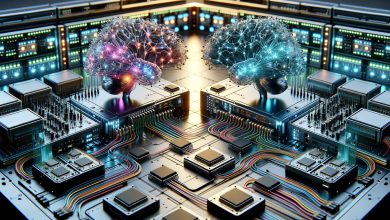
Think of Quantum AI as a hybrid workflow where quantum circuits complement classical ML. The basic unit is a qubit, which can be in a superposition of 0 and 1 at the same time. Entanglement links qubits in ways that have no classical equivalent, enabling correlated transformations across many states simultaneously. Interference lets you amplify “good” solutions and cancel out “bad” ones—useful in search, optimization, and sampling.
In practice, Quantum AI uses parameterized quantum circuits (also called variational quantum circuits or VQCs) trained alongside classical optimizers. You initialize a circuit, encode data into qubit states, run the circuit on a quantum device or simulator, measure outcomes, compute a loss, and update parameters with a classical optimizer. This loop is similar to training neural networks, but the “layer” in the middle is quantum.
Common building blocks include quantum kernels (for classification and clustering), the Quantum Approximate Optimization Algorithm (QAOA) for combinatorial problems, and quantum-enhanced feature maps that inject rich, high-dimensional structure. Quantum linear algebra routines are researched for speeding up subproblems like solving systems or estimating properties of matrices, though many theoretical speedups depend on strong assumptions about data access and error rates.
Real-world Quantum AI today is NISQ-era: noisy, intermediate-scale quantum. Devices have limited qubit counts and imperfect gates, so robustness is crucial. That’s where error mitigation and careful circuit design come in. Developers mix classical pre-processing, shallow circuits, and post-processing to reduce noise impact. You also don’t need a quantum data center: cloud platforms give managed access to real hardware and high-performance simulators. The upshot is that you can prototype hybrid models now, learn what encodings and circuits fit your domain, and be ready to scale as fault-tolerant machines emerge.
Where quantum computing transforms machine learning today
Quantum AI won’t replace deep learning wholesale, but it can augment ML for specific pain points. The most promising areas cluster around optimization, kernel methods, and probabilistic modeling—places where exploring many possibilities or shaping complex distributions matters.
– Optimization and decision-making: Portfolio construction, routing, scheduling, and resource allocation often reduce to combinatorial problems. Variants of QAOA or quantum-inspired approaches can search these spaces differently than classical heuristics. Even when quantum hardware isn’t big enough, the process of framing the problem for QAOA can inspire better classical baselines.
– Quantum kernels and feature maps: Support Vector Machines with quantum kernels (QSVMs) use quantum circuits to compute similarity in a high-dimensional feature space that may be hard to emulate classically. On certain synthetic datasets, QSVMs have shown separations that favor quantum kernels, though robust real-world advantages remain under study.
– Sampling and generative modeling: Training energy-based models or sampling from tough distributions can be sluggish. Quantum circuits can generate probability distributions natively, suggesting pathways to faster or richer samplers. Early experiments explore quantum Boltzmann machines and variational generative models, with practical advantage still an open question.
– Scientific ML: Chemistry and materials problems blend physics with ML. Hybrid pipelines can use quantum circuits to estimate molecular properties or ground-state energies (e.g., VQE), then feed results into classical models for discovery. Even partial quantum subroutines can reduce error bars or guide search more efficiently than brute force.
– Quantum-inspired wins: Research into tensor networks and low-rank factorizations—motivated by quantum ideas—has already improved classical ML in areas like recommender systems and sequence modeling. You can benefit from the QML mindset even before hitting quantum hardware limits.
Snapshot of readiness and expectations (as of 2024):
| ML Task | Quantum Angle | Why It Could Help | Current Maturity |
|---|---|---|---|
| Combinatorial optimization | QAOA, annealing, hybrids | Parallel exploration, interference | Pilots/benchmarks; advantage task-dependent |
| Kernel methods | Quantum feature maps | Rich high-dimensional embeddings | Promising demos; real-world proof pending |
| Sampling/generative | Quantum circuit samplers | Native probability generation | Early research; limited scale |
| Chemistry/materials | VQE + ML surrogates | Physics-grounded features | Active research; small systems |
Bottom line: treat Quantum AI as a targeted accelerator. Start with subproblems where structure, symmetry, or rugged landscapes slow classical pipelines. Use benchmarks and ablation studies to test whether a quantum component improves quality, speed, or cost for your specific workload.
How to start with Quantum ML: tools, steps, and realistic expectations
Getting hands-on is easier than it sounds. You can prototype hybrid models locally and run on real devices via the cloud when ready. Here’s a practical path to begin, without a PhD in physics.
– Choose a framework: Qiskit from IBM is popular for building circuits and running on real superconducting devices via the IBM Quantum Platform. Cirq from Google focuses on circuit design and simulation. PennyLane by Xanadu connects quantum circuits to PyTorch/JAX/TensorFlow for end-to-end autodiff. TensorFlow Quantum integrates quantum layers into TF graphs. Pick the ecosystem that fits your stack and community. Explore docs at Qiskit, Cirq, and PennyLane.
– Access hardware: You don’t need to buy a quantum computer. Try managed services: IBM Quantum for superconducting devices; Azure Quantum for access to IonQ, Quantinuum, and more; Amazon Braket for Rigetti, IonQ, and simulators. Start on simulators, then validate key experiments on small real devices.
– Frame the right problem: Identify a bottleneck subroutine—e.g., a kernel computation, a sampler, or a discrete optimizer. Encode your data efficiently (amplitude or angle encoding) while keeping circuits shallow. Heavy data-loading can erase quantum benefits, so prefer feature maps that scale with modest gate depth.
– Train hybrid models: Use classical optimizers (Adam, SPSA, COBYLA) to tune circuit parameters. Measure with many shots to reduce variance. Add error mitigation techniques like zero-noise extrapolation. Compare against strong classical baselines to avoid fooling yourself.
– Measure ROI: Define success in three axes—quality (accuracy, regret, energy estimate), speed (wall-clock, queue time), and cost (cloud credits, engineering complexity). For now, the goal is capability building and discovering niches where quantum components add value, not wholesale replacement of GPUs.
– Stay realistic: Today’s devices are noisy with limited qubits. Many published speedups are theoretical or constrained by assumptions like fast quantum RAM. Benchmarks should be task-specific and reproducible. Follow reputable sources like Stanford AI Index and vendor roadmaps to set expectations.
Pro tip: time-box your pilot. In 6–8 weeks, aim to build a baseline classical solution, a hybrid prototype, and a fair comparison. Document lessons and decide whether to scale, shelve, or shift focus.
Q&A: quick answers to common questions about Quantum AI
Q1: Will quantum computers replace GPUs for machine learning? A: Not anytime soon. GPUs and TPUs are extraordinary for dense linear algebra and deep learning at scale. Quantum devices are better viewed as specialized co-processors for specific subproblems—optimization, kernels, or sampling—inside a larger classical ML pipeline. The most likely future is hybrid: CPUs/GPUs handle most work, while quantum accelerators tackle targeted tasks where they can help.
Q2: Do I need to learn advanced quantum physics to use Quantum AI? A: You can start without diving deep into physics. Frameworks like Qiskit, PennyLane, and Cirq abstract many details and integrate with familiar ML stacks. Basic concepts—qubits, gates, measurements, superposition—are enough for prototyping. As you progress, understanding noise, error mitigation, and circuit design will help you reason about performance and limitations.
Q3: Can Quantum AI deliver business value today? A: It’s possible in narrow, well-chosen pilots, especially in optimization-heavy workflows where even small improvements matter. However, broad, repeatable quantum advantage across general ML tasks hasn’t been demonstrated. Think of current efforts as R&D that prepares your team for near-future opportunities while uncovering insights you can often transfer back to classical systems.
Q4: How does data get into a quantum computer? Isn’t that a bottleneck? A: Data must be encoded into quantum states via gates, which takes time and introduces error. Designing efficient feature maps and using summary statistics or learned embeddings can reduce the load. The benefit of a quantum step must outweigh this overhead, which is why focusing on compact, information-rich encodings is critical.
Q5: When will we see practical quantum advantage for ML? A: Timelines are uncertain. As of 2024, researchers have shown compelling quantum experiments and progress in error suppression and control, but fully fault-tolerant, large-scale machines are still in development. Expect targeted advantages in niche problems first, with broader impact arriving gradually as hardware, error correction, and algorithms mature.
Conclusion: a focused, actionable path into Quantum AI
Here’s the big picture: classical ML is straining under compute, cost, and energy pressure, especially for optimization, sampling, and high-dimensional similarity. Quantum AI offers a complementary toolbox that can reshape how we explore solution spaces and encode complex features. While hardware remains noisy and small, hybrid quantum-classical workflows already let you prototype, test assumptions, and learn where quantum effects might help your specific workloads.
If you’re ready to move, start simple and practical. Pick one concrete bottleneck—like a kernel similarity step, a sampler in a generative pipeline, or a small optimization task with business relevance. Build a strong classical baseline. Then implement a quantum variant using Qiskit, Cirq, or PennyLane. Run first on simulators, and validate key experiments on real hardware through IBM Quantum, Azure Quantum, or Amazon Braket. Track accuracy, speed, and cost. Document what works, what doesn’t, and why. Use those insights to guide your next experiment or to improve your classical approach—either outcome is a win.
Make this a team effort: upskill interested engineers, pair an ML lead with a quantum-curious developer, and set a tight pilot timeline (6–8 weeks). Share results openly, including negative findings, to build organizational knowledge. Keep expectations grounded by following independent benchmarks and peer-reviewed studies, and treat vendor claims as starting points for your own tests.
Call to action: choose one candidate problem today, spin up a free or low-cost account on a quantum cloud platform, and complete a tutorial that matches your use case. Even a small prototype can demystify Quantum AI and position your team ahead of the curve. The future of intelligent systems is hybrid—built by people who experiment early, measure honestly, and iterate fast. Are you ready to be one of them?
Sources and further reading:
– IBM Quantum and Qiskit: https://quantum-computing.ibm.com/ and https://qiskit.org/
– Google Quantum AI and Cirq: https://quantumai.google/ and https://quantumai.google/cirq
– Microsoft Azure Quantum: https://azure.microsoft.com/en-us/products/quantum
– Amazon Braket: https://aws.amazon.com/braket/
– PennyLane (hybrid quantum ML): https://pennylane.ai/
– Stanford AI Index (context on compute trends): https://aiindex.stanford.edu/
– Survey on Quantum Machine Learning (arXiv): https://arxiv.org/abs/2011.01367
– Error mitigation and progress toward fault tolerance (Nature): https://www.nature.com/collections/ncqec