

Robotics and AI are no longer futuristic buzzwords—they are practical tools reshaping how work gets done. The main problem many people face today is a growing gap between what businesses need and what current processes can deliver: labor shortages, rising costs, safety risks, and inconsistent quality. Robotics and AI address these pain points by automating repetitive tasks, improving decision-making, and unlocking new productivity. But adoption can feel complex. This article shows you what works, what to avoid, and how to make Robotics and AI a force multiplier for your team and your organization.
Sponsored Ads
The Problem: Automation, Labor, and the Productivity Gap
Across industries, the pressure is the same: do more with less. Manufacturers face fluctuating demand and shortages of skilled technicians. Logistics teams must deliver faster with fewer errors. Hospitals juggle high patient loads, safety protocols, and documentation. Agriculture battles climate variability and the need for consistent yields. Without smarter automation, many organizations fall into a cycle of firefighting: short-term fixes, overtime, and manual workarounds that burn people out and erode margins.
Three trends intensify the challenge. First, demographics. Global populations are aging, and younger workers often favor creative or flexible roles over repetitive, physically demanding tasks. Second, complexity. Supply chains, compliance requirements, and product customization have multiplied the number of variables frontline teams must manage. Third, competition. Digital-native companies set a high bar for speed and consistency, pushing everyone else to modernize or lose market share.
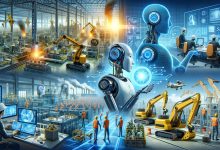
Traditional automation alone is not enough. Fixed robots or rigid scripts struggle when real-world conditions change—like irregular parts, variable lighting, or unpredictable customer demand. That is where Robotics and AI come together. Robots provide strength, precision, and repeatability. AI provides perception, prediction, and adaptation. Combined, they upgrade automation from “fast but brittle” to “fast and flexible.”
There is also a human side to the gap. Workers want safer jobs with clearer growth paths. Leaders want measurable ROI without multi-year bets that might not scale. Customers want better service without higher prices. The good news: well-designed Robotics and AI programs can balance all three. Cobots (collaborative robots) reduce ergonomic strain. Computer vision improves quality without slowing the line. Intelligent scheduling cuts idle time and rush fees. When the system is built around real workflows—rather than technology for technology’s sake—robots and algorithms support people instead of replacing them.
How Robotics and AI Actually Work Together
To make sense of the hype, break the system into three layers: seeing, thinking, and doing. AI-powered perception lets machines “see” with cameras, lidar, or depth sensors. This includes computer vision models that detect defects, read labels, or recognize objects even when conditions shift. The thinking layer turns raw sensor data into decisions: path planning for mobile robots, grasp selection for manipulators, or scheduling for fleets of bots. The doing layer is the robot hardware—arms, grippers, mobile bases—executing tasks with precision and repeatability. The magic appears when these layers form a closed loop: sense the world, decide what to do, act, then learn from the result.
Recent advances have accelerated each layer. Foundation models and generative AI help robots generalize across new parts and tasks with fewer examples, reducing lengthy reprogramming. Edge computing brings low-latency inference to the factory floor, avoiding delays from cloud round-trips and keeping sensitive data onsite. Digital twins mirror real operations in simulation, letting teams test new layouts or robot paths safely before deployment. Meanwhile, cobots designed to work near people follow safety standards (such as ISO/TS 15066 for collaborative operations) to limit force and speed during contact.
One practical pattern that teams use is a “human-in-the-loop” design. For example, a vision system flags uncertain classifications to a human supervisor, who resolves them in seconds. The model then retrains on those edge cases, improving over time. Another pattern is staged autonomy. Start with assistive modes—pick-to-light guidance or robotic presentation of parts—then progress to semi- or fully autonomous tasks as reliability proves out. This reduces risk and builds trust on the shop floor.
Integration matters as much as algorithms. Robots must connect to existing MES/ERP systems, WMS in warehouses, or EHRs in hospitals. Standard APIs, event streams, and robust data governance prevent “automation islands” that are hard to maintain. Safety and cybersecurity are first-class requirements: robot cells need guarding, emergency stops, and clearly documented procedures; networks need segmentation and monitoring. When implemented thoughtfully, the result is a flexible cell or workflow that adapts to product changes, shifts, and demand spikes without weeks of reprogramming.
Industry Transformation: From Factory Floors to Hospitals and Farms
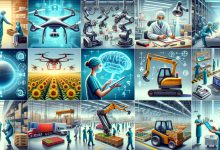
Different sectors adopt Robotics and AI in distinct ways, but the goals rhyme: safety, quality, speed, and resilience.
Manufacturing uses robotic arms and cobots for assembly, screwdriving, dispensing, and inspection. Computer vision checks surface defects or missing components. AI scheduling aligns machines, materials, and people to reduce changeover time. Autonomous mobile robots (AMRs) shuttle parts to the right stations, cutting forklift traffic. In electronics, vision-guided robots manage delicate components; in metals, AI optimizes weld parameters for stronger joints.
Logistics and e-commerce rely on AMRs, automated storage and retrieval systems (AS/RS), and smart picking. AI predicts order volume and optimizes slotting. Vision and RFID keep inventory accurate. In a typical warehouse, robots bring shelves to human pickers or vice versa, while software orchestrates who does what to minimize congestion. The result is faster fulfillment with fewer walking miles and fewer errors, especially during peak seasons.
In healthcare, robots assist with pharmacy dispensing, lab sample handling, and UV disinfection. AI triage tools help prioritize tasks, and computer vision supports inventory checks for PPE and medications. The emphasis is on reducing infection risk and freeing clinicians for patient-facing work. For agriculture, robotic harvesters, autonomous tractors, and AI-driven scouting detect pests, nutrient issues, and ripeness, allowing targeted interventions that save water and inputs. Vision-based grading improves quality consistency—key for global supply chains.
Below is a quick snapshot of credible data points that illustrate the momentum and context for these shifts:
| Fact or Metric | Why It Matters | Source |
|---|---|---|
| 553,000 industrial robots installed globally in 2022 (record year) | Signals mainstream adoption and falling barriers to entry | International Federation of Robotics |
| South Korea’s robot density in manufacturing exceeds 1,000 per 10,000 employees | High robot density correlates with competitive manufacturing | IFR Robot Density |
| Generative AI could add $2.6–$4.4 trillion in annual economic impact | AI’s value expands beyond automation into decision and design | McKinsey |
| Global population ageing: by 2030, 1 in 6 people will be 60+ | Automation helps maintain output as workforces age | United Nations |
| Warehouse robots can lift picking productivity significantly | Case studies report notable gains with cobots and AMRs | DHL Robotics Insights |
The takeaway: Robotics and AI are not a niche. They are becoming utilities—like electricity or broadband—for physical work. If you manage operations, your strategic decision is not “if” but “how” and “how fast.” Pick use cases with clear pain points, measurable outcomes, and friendly workflows for your teams. Then scale with a blueprint that reduces integration friction and keeps safety front and center.
People, Skills, and the Implementation Playbook
The biggest misconception is that robots “take jobs.” In reality, they change jobs. Tasks that are dull, dirty, or dangerous shift to machines; humans move to oversight, exception handling, continuous improvement, programming, and customer-facing roles. This is already visible in factories that upskill operators into robot technicians, in warehouses where pickers become flow coordinators, and in hospitals where clinicians delegate routine logistics to autonomous carts and spend more time with patients.
For teams, the shift is an opportunity to build future-proof skills. Practical upskilling paths include: basic robot operation and safety; low-code robot programming; computer vision basics; data literacy; and workflow design. Many platforms now offer drag-and-drop or no-code tools that let non-specialists set up tasks, while online micro-credentials provide fast, affordable learning. Pair this with mentorship on the floor: shadowing experienced integrators for a few sprints builds confidence quickly.
To deploy Robotics and AI with confidence, use a simple, repeatable playbook:




- Define one critical use case. Example: reduce inspection defects by 30%, or cut internal transport time by 20%.
- Map the current workflow end-to-end. Note handoffs, bottlenecks, and failure modes. Identify safety and cybersecurity requirements up front.
- Run a low-risk pilot. Use simulation and a small cell or aisle. Collect baseline data and post-pilot metrics that everyone trusts.
- Design for people. Co-create SOPs with operators. Add clear signals (lights, sounds), easy e-stops, and intuitive HMI screens.
- Harden and integrate. Connect to MES/WMS/ERP via APIs. Add monitoring for uptime, battery health, vision accuracy, and model drift.
- Scale with governance. Use a center-of-excellence model, standard templates, and a backlog of prioritized use cases.
Safety and ethics are non-negotiable. Align with recognized frameworks such as the NIST AI Risk Management Framework, follow robot safety standards like ISO 10218 and ISO/TS 15066, and maintain clear policies for data privacy. Consider regional regulations (for example, the evolving EU AI Act) and ensure procurement includes cybersecurity requirements and software bill of materials (SBOMs). For warehouses and plants in the U.S., consult OSHA’s robotics guidance and perform risk assessments before go-live. These steps protect people, reduce downtime, and build long-term trust in the system.
Q&A: Common Questions About Robotics and AI
Q1: Will Robotics and AI eliminate my job?
A: They change tasks more than entire roles. Routine, repetitive work shifts to machines; humans focus on oversight, problem-solving, quality, and customer value. Employers that invest in reskilling see smoother transitions and higher engagement.
Q2: How do I estimate ROI?
A: Start with time and error reduction on a single process. Measure baseline cycle time, defect rates, and incident counts. After a pilot, compare improvements and include maintenance, training, and integration costs. Aim for 6–18 months payback for early wins.
Q3: Do I need a data science team?
A: Not to start. Many vendors offer pre-trained models and low-code tools. However, having at least one internal champion who understands data quality, model monitoring, and integration will accelerate scaling.
Q4: Is the technology reliable enough for small and mid-sized businesses?
A: Yes. Cobots, AMRs, and vision kits are more affordable and easier to deploy than ever. Start small—one cell or zone—and expand as reliability proves out.
Conclusion: Your Next Step Into a Human + Machine Future
We began with a reality check: today’s operations face labor shortages, rising complexity, and the need for consistent quality and speed. Robotics and AI directly address these pressures by pairing mechanical precision with adaptive intelligence. You saw how perception, planning, and actuation combine to deliver flexible automation; how sectors from manufacturing to healthcare and agriculture use these tools for safer, faster, and more reliable work; and how the real differentiator is not the robot arm or the model alone, but the end-to-end system that integrates people, software, and hardware with safety and governance.
The path forward is practical. Choose one high-impact use case, run a measured pilot, and build internal capability as you scale. Treat safety, data, and ethics as design inputs—not afterthoughts. Invest in your people with micro-credentials and hands-on mentorship so they can operate, improve, and extend your systems. Leverage published frameworks and standards to reduce risk and accelerate approvals. Most importantly, keep work human-centered: design robots to remove drudgery, reduce injuries, and elevate the uniquely human skills of judgment, creativity, and care.
If you are ready to move, pick a process this week. Map it, set a clear target (for example, “cut changeover by 20%” or “halve inspection escapes”), and talk to two vendors or integrators about a time-boxed pilot. Use simulation to de-risk, track a small set of KPIs, and hold a retrospective with the team. Repeat what works, retire what does not, and share the wins. Momentum compounds.
The future of work is not man versus machine—it is teams of people augmented by intelligent tools, building safer, smarter, and more resilient operations. What is the one task in your world that you would most want a reliable robot or AI system to handle next? Start there, and take the first step today.
Sources
- International Federation of Robotics: Robot installations reach new record
- International Federation of Robotics: Global robot density
- McKinsey: The economic potential of generative AI
- United Nations: World Population Ageing
- DHL: Robotics and automation insights
- NIST: AI Risk Management Framework
- ISO 10218: Robots and robotic devices — Safety requirements
- ISO/TS 15066: Collaborative robot operation
- OSHA: Robotics safety
- European Commission: EU AI Act (overview)
- NVIDIA Omniverse: Digital twins