If you’re trying to choose the right chips for AI in 2025, you’ve probably hit a wall of acronyms, hype, and long waitlists. This AI Hardware 2025 guide cuts through the noise. In plain language, we explain chips, GPUs, and accelerators, how they differ, and what matters for your workload. Whether you’re fine-tuning a 7B model on a budget or scaling a global LLM service, this guide will help you decide faster and avoid expensive detours.
Sponsored Ads
The real problem in 2025: matching your workload to the right AI hardware
The hardest part of AI hardware in 2025 isn’t reading spec sheets—it’s mapping your specific workload to a system that’s available, affordable, and easy to run. Marketing focuses on peak FLOPs, but most production bottlenecks are memory, interconnect, or software stack maturity. The same model can fly on one stack and crawl on another simply because of kernel availability or how your data pipeline saturates PCIe or the network.
Teams commonly overbuy compute and underbuy memory or interconnect. For example, large-context generative AI and retrieval-augmented generation are often memory-bound, not compute-bound. If your model relies on long contexts, multi-turn sessions, or high batch sizes, your KV cache can exceed the size of the model weights—pushing you to higher HBM capacity or multi-device sharding. Conversely, vision or speech models with compact activations can be compute-bound and scale nicely with more chips.
Another trap is ignoring software ecosystems. CUDA’s maturity can shorten engineering time; ROCm has improved rapidly and is production-worthy for many LLM and vision tasks; platform accelerators (TPU, Trainium, Gaudi) offer strong price-performance if your framework and operators are supported. Before buying, run a smoke test: train a small model end-to-end and serve it with your target stack. Public benchmarks like MLPerf provide helpful context for training and inference performance across vendors, but your workload mix will differ. See MLPerf at https://mlcommons.org/en/.
Finally, procurement reality matters. The best chip for your use case is the one you can reliably get capacity for—on-prem, via cloud instances, or through managed services. Don’t forget ops: drivers, firmware, container images, cluster schedulers, and observability tooling usually decide whether your team ships on time.
Chips, GPUs, and accelerators explained: what each is best at
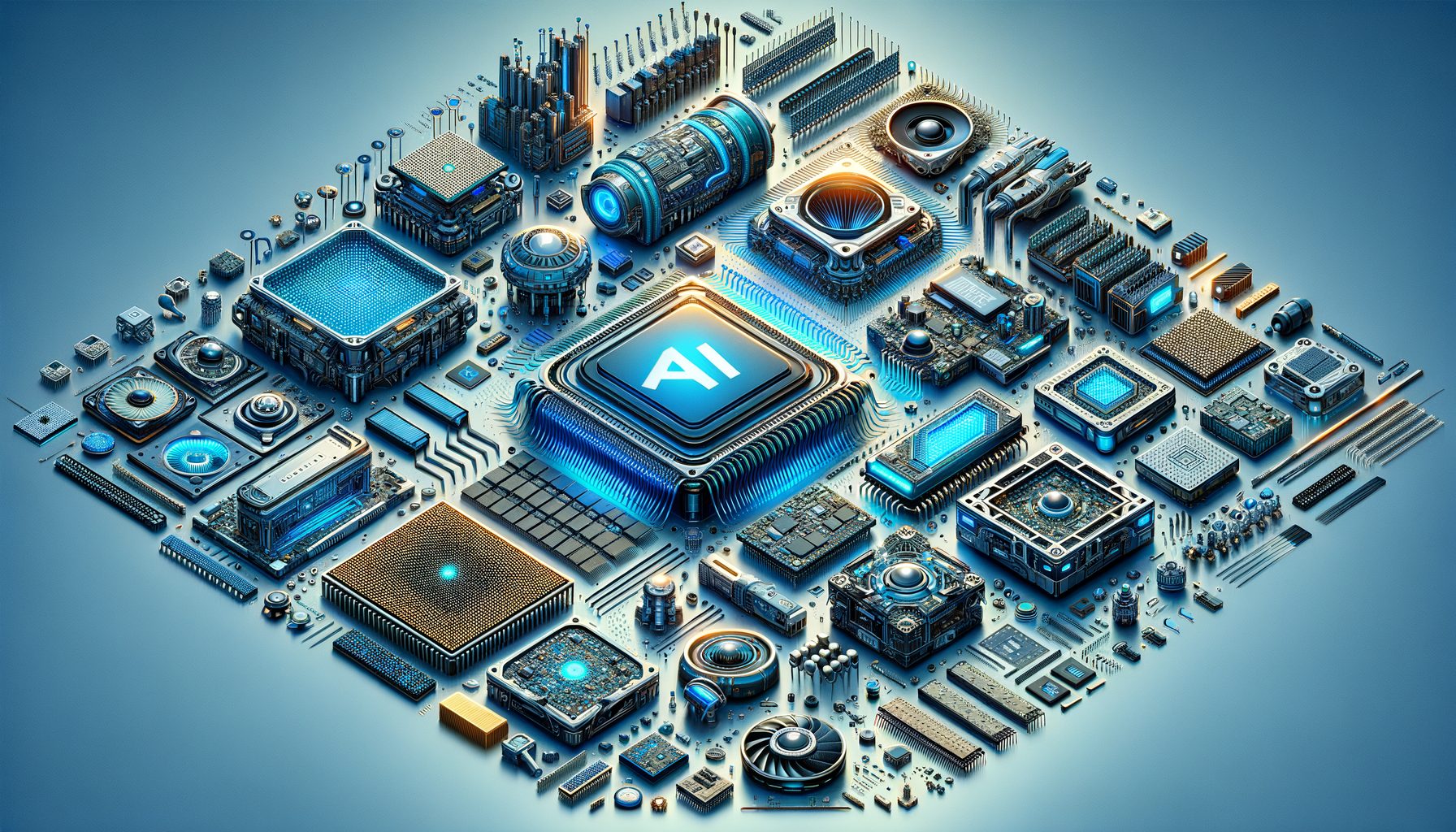
“Chip” is the generic term; “GPU” is a graphics processing unit that now dominates AI compute; “accelerator” covers specialized devices for AI beyond traditional GPUs. Here’s how the main options compare in practice.
GPUs remain the default for general-purpose AI. NVIDIA’s data center GPUs (from A100/H100/H200 to Blackwell-generation B200/GB200) pair strong tensor cores with a deep CUDA ecosystem, mature libraries (cuBLAS, cuDNN), and tooling like TensorRT-LLM for inference optimization. If you need the broadest framework support, many pretrained models, and robust multi-node scaling options, GPUs are the safe bet. Learn more: https://www.nvidia.com/en-us/data-center/blackwell/.
AMD’s MI300 family offers competitive memory capacity and bandwidth, and ROCm has made big strides in PyTorch, vLLM, and popular LLM/vision workloads. For teams willing to validate kernels and stay near mainstream frameworks, AMD can deliver excellent price-performance, especially for memory-hungry models. See ROCm: https://rocmdocs.amd.com/.
AI accelerators shine when your stack aligns with them. Google Cloud TPUs (v4, v5e, v5p) are designed for scale-out training and serve JAX and PyTorch/XLA well. AWS Trainium targets cost-efficient training and pairs with Inferentia for inference via the Neuron SDK. Intel Gaudi (2/3) integrates high-speed Ethernet for scale-out and offers a competitive software stack for common LLMs and vision models. Cerebras’s wafer-scale engine (WSE-3) focuses on simplifying large-model training without complex parallelism. Explore docs: TPU at https://cloud.google.com/tpu, Trainium at https://aws.amazon.com/machine-learning/trainium/, Gaudi at https://www.intel.com/content/www/us/en/products/details/processors/gaudi.html, Cerebras at https://www.cerebras.net/.
CPUs and NPUs hold important roles. CPUs orchestrate data loading, tokenization, and control logic; modern NPUs in laptops and phones enable private, low-latency on-device AI for summarization, translation, and image features. If your priority is privacy or offline functionality, optimizing a small model for an NPU (or a CPU with AVX/AMX/NEON) can be the right move.
Rule of thumb: pick GPUs for maximum flexibility and community support; choose platform accelerators when your framework has first-class support and you can capture a cost or availability advantage; keep CPUs/NPUs for orchestration and edge scenarios.
Memory, interconnect, and scaling: the invisible limits that make or break performance
For modern transformers, memory and interconnect dominate real-world performance. HBM capacity decides whether your model fits on a device without sharding; HBM bandwidth feeds your compute units; interconnect (NVLink/Infinity Fabric/PCIe/Ethernet/InfiniBand) determines how efficiently multiple devices act like one logical accelerator.
Weights are only part of the story. During inference, KV cache grows with sequence length, number of layers, attention heads, and batch size. With long contexts and concurrency, KV cache can exceed weights by a wide margin. During training, activations for backpropagation add additional memory pressure. Techniques like quantization (INT8/FP8/4-bit), gradient checkpointing, activation recomputation, FlashAttention, and tensor/sequence parallelism cut memory and bandwidth demands, but they add software complexity.
Interconnect defines your scaling ceiling. In a single node, high-speed links like NVLink or similar enable fast all-reduce and tensor parallelism. Across nodes, InfiniBand or Ethernet with RoCE carries gradients and parameters; good collectives libraries and topology-aware schedulers are essential. If your job spends a lot of time in all-reduce, your effective throughput might be limited by network bandwidth and latency, not raw FLOPs.
Keep these approximate numbers in mind when reasoning about bottlenecks:
| Level | Where data sits | Approx bandwidth | Typical latency | Best for |
|---|---|---|---|---|
| HBM on accelerator | On-package memory | 1–5+ TB/s | ~100–300 ns | Weights, activations, KV cache |
| GPU-to-GPU high-speed link | NVLink/Infinity Fabric | 50–900 GB/s (gen-dependent) | ~0.3–1.5 µs | Tensor/sequence parallelism within a node |
| PCIe Gen4/Gen5 | Device-to-host or peer | 32–64 GB/s (x16) | ~1–3 µs | Data ingest, control, moderate peer comms |
| Ethernet/InfiniBand | Node-to-node networking | 25–100 GB/s (200–800 Gbps) | ~1–10 µs | Distributed training/inference scale-out |
Practical tip: Start capacity planning from memory, not compute. For example, a 13B model quantized to 4-bit needs roughly 6–7 GB for weights, but your KV cache for 8 concurrent 4k-token requests can add tens of GB. For training, estimate batch size and sequence length first; then decide how to shard across devices and what interconnect is required to keep utilization high. Public references like MLPerf Training and Inference results can validate assumptions: https://mlcommons.org/en/.
Training vs inference economics—and a practical buying checklist
Training and inference have different bottlenecks and economics. Training is a throughput game: examples or tokens processed per second, sustained over long runs with high cluster utilization. Your limiting factors are often input pipelines (storage, CPU preprocessing), interconnect for all-reduce, and memory bandwidth for attention. Mixed precision (FP8/FP16) is standard, with loss scaling and optimizer sharding to fit larger models.
Inference is a latency and concurrency game. Key metrics include tokens-per-second per request, p50/p95 latency, and cost-per-1k tokens. Techniques like continuous batching (vLLM), paged KV cache, and quantization deliver big wins. Platform tools like TensorRT-LLM (NVIDIA), ROCm graph execution, AWS Neuron for Inferentia, and PyTorch/XLA for TPU streamline optimized serving. See vLLM: https://vllm.ai/ and TensorRT-LLM: https://github.com/NVIDIA/TensorRT-LLM.
Total cost of ownership blends hardware price, energy, cooling, real estate, and ops. A single high-end accelerator can draw 600–1000W; an 8-accelerator server can exceed 6–8 kW. In the cloud, the equivalent appears in your hourly rate. Don’t forget power usage effectiveness (PUE) and staff time for cluster maintenance, driver updates, and observability.
Use this checklist to choose confidently:
1) Define the model(s): parameter count, context length, target latency, and accuracy tolerance (e.g., INT8 or 4-bit OK?). 2) Pick the primary framework and must-have kernels (PyTorch, JAX, Triton, ONNX). 3) Decide single-node vs multi-node scale; list interconnect needs. 4) Size memory first (weights + activations/KV cache + headroom). 5) Validate software support on your target stack (CUDA/ROCm/Neuron/XLA/SynapseAI). 6) Run a quick pilot: fine-tune a small model and serve it with your real data. 7) Compare price-performance across at least two options (on-prem vs cloud), including energy/ops. 8) Check supply and support: delivery dates, managed options, and SLAs.
If you align these eight steps with your team’s skills and timeline, you’ll avoid most bad surprises.
Quick Q&A: fast answers to common AI hardware questions
Q: Should I wait for the “next GPU generation” or buy what’s available now? A: If you have a clear business need, buy what you can actually get and run today. New chips often launch with limited supply and early software wrinkles. Unless a specific feature (like higher HBM capacity) is essential for your workload, shipping sooner typically beats waiting. Keep contracts flexible so you can add newer parts later.
Q: Do I need a GPU, or will a platform accelerator (TPU, Trainium, Gaudi) be cheaper? A: It depends on your stack. If your models and frameworks map cleanly (PyTorch/XLA on TPU, Neuron on Trainium/Inferentia, SynapseAI on Gaudi), platform accelerators can offer strong price-performance and easier scale-out. If you need maximum library coverage, third-party wheels, or niche ops, GPUs usually minimize engineering time.
Q: How much memory do I need for common LLM sizes? A: Rough thumb-rules for inference: 7B at 4-bit fits comfortably in 4–6 GB for weights, 13B in 6–8 GB, 33–70B in tens of GB. But KV cache can dwarf weights for long contexts and many concurrent users. Always estimate weights plus KV cache at your target batch and sequence length. For training, add activations; you’ll likely need multiple devices or gradient checkpointing for 13B+.
Q: Can I train large models on Ethernet, or do I need InfiniBand? A: Both work. InfiniBand gives lower latency and mature collectives, which helps scaling efficiency on very large jobs. Modern Ethernet with RoCE and good software (NCCL, Gloo, vendor libraries) can train competitively, especially up to a few racks. Profile your all-reduce time; if communication dominates, higher-performance networks pay off.
Q: Is FP8 or INT8 safe for quality? A: For many models, yes—when paired with proper calibration or mixed-precision recipes. Training often uses FP8/FP16 mixes; inference routinely uses INT8 or 4-bit weight-only quantization. Always A/B test on your real metrics; the right quantization can cut cost and latency with minimal quality loss.
Conclusion
This guide unpacked the practical choices behind AI hardware in 2025: why the problem is really about matching workloads to memory and interconnect, how GPUs and accelerators differ in ecosystems and strengths, what HBM and networking mean for scaling, and how to think about training versus inference economics. The bottom line is simple: start from your model and latency goals, size memory before compute, validate the software stack with a small pilot, and only then lock in procurement. Benchmarks and spec sheets are helpful, but your data and pipelines decide the winner.
Your next step: write down your top workload (model size, context length, target latency), pick two candidate stacks (for example, GPU with CUDA and a platform accelerator that your framework supports), and run a one-week bake-off using a realistic dataset and traffic pattern. Measure tokens-per-second, p95 latency, and cost-per-1k tokens. Keep a scorecard and choose the setup that meets your SLA with the least operational friction. If you’re constrained by supply, book capacity early and consider a hybrid plan (cloud now, on-prem later).
AI moves fast, but good engineering habits don’t change: profile, measure, iterate. With a clear checklist and a short pilot, you’ll avoid most of the costly mistakes and get your models into production faster. Share this guide with your team, bookmark the benchmark links, and start your bake-off this week. What’s the one metric you’ll optimize first: latency, cost, or scale? Choose it, own it, and let it guide every hardware decision you make.
Outbound references
MLPerf (MLCommons) benchmarks: https://mlcommons.org/en/
NVIDIA Blackwell architecture: https://www.nvidia.com/en-us/data-center/blackwell/
AMD ROCm documentation: https://rocmdocs.amd.com/
Intel Gaudi platform: https://www.intel.com/content/www/us/en/products/details/processors/gaudi.html
Google Cloud TPU docs: https://cloud.google.com/tpu
AWS Trainium and Inferentia (Neuron SDK): https://aws.amazon.com/machine-learning/trainium/ and https://aws.amazon.com/machine-learning/inferentia/
Cerebras WSE: https://www.cerebras.net/
OpenXLA project: https://openxla.org/
vLLM: https://vllm.ai/
TensorRT-LLM: https://github.com/NVIDIA/TensorRT-LLM
Sources
MLCommons MLPerf Training and Inference results: https://mlcommons.org/en/
NVIDIA data center platform pages and technical blogs: https://www.nvidia.com/en-us/data-center/
AMD Instinct and ROCm documentation: https://www.amd.com/en/products/accelerators/instinct and https://rocmdocs.amd.com/
Intel Gaudi documentation and whitepapers: https://www.intel.com/content/www/us/en/products/details/processors/gaudi.html
Google Cloud TPU documentation: https://cloud.google.com/tpu/docs
AWS Neuron SDK docs for Trainium/Inferentia: https://awsdocs-neuron.readthedocs-hosted.com/
Cerebras technical resources: https://www.cerebras.net/resources/
OpenXLA community: https://openxla.org/
vLLM and TensorRT-LLM docs and repos: https://vllm.ai/ and https://github.com/NVIDIA/TensorRT-LLM