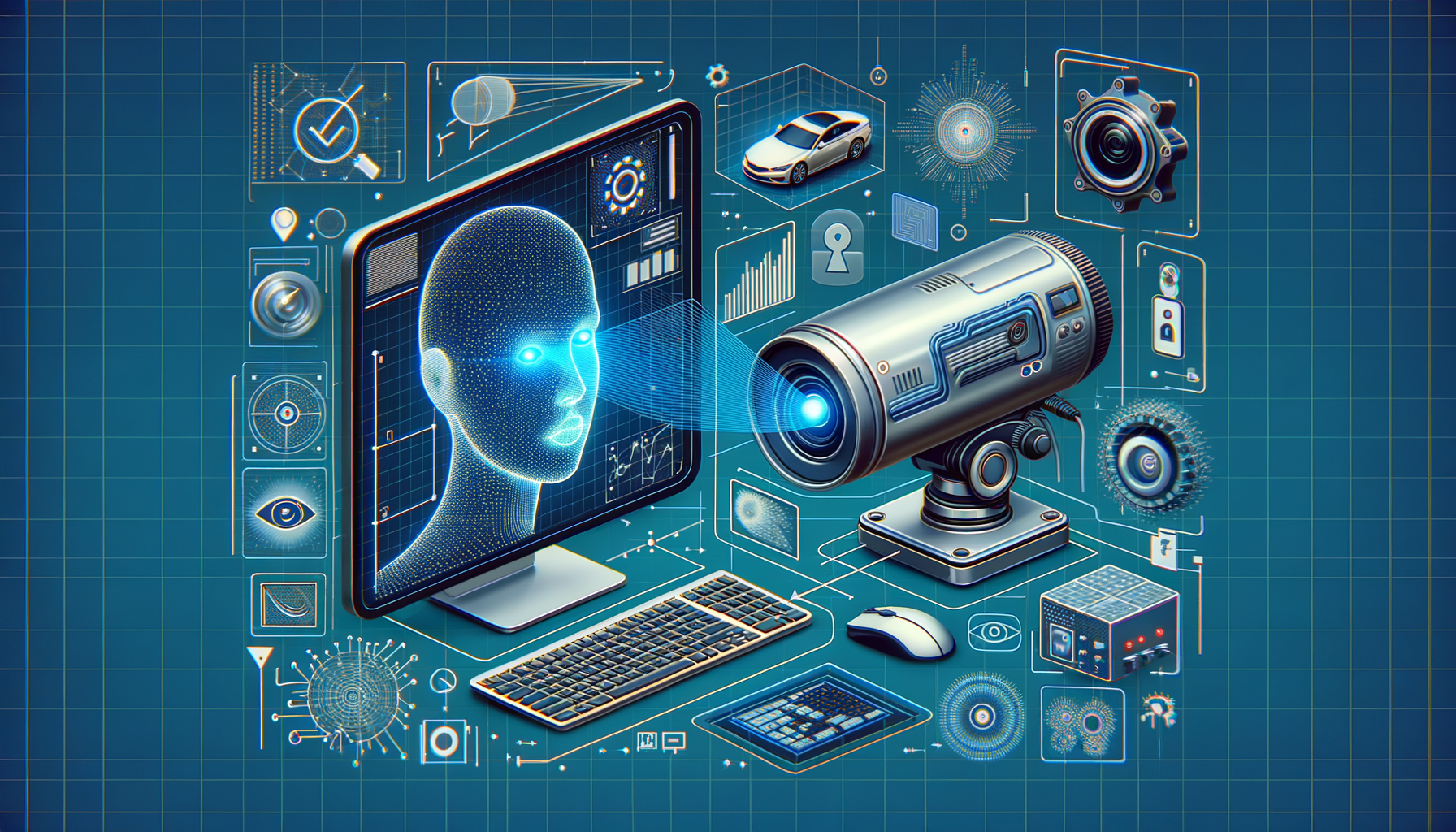
Computer vision is how machines make sense of images and video—detecting faces, reading street signs, checking product quality, and more. The main problem? Most teams know computer vision is powerful but struggle to understand what techniques to use, which tools to pick, how to get data, and how to deploy models reliably. This guide offers computer vision explained in a clear, practical way, covering AI techniques, tools, and real use cases, so you can move from idea to production with confidence.
Sponsored Ads
Why Computer Vision Matters Today: The Problem and the Promise
Every business now records visual data: smartphones, security cameras, drones, dashboards, and social feeds. Yet most organizations barely use it. Valuable insights are locked inside pixels—quality defects that slip through, safety risks that go unnoticed, medical patterns that are hard to spot, and user experiences that could be personalized if only we could “see” at scale.
That’s where computer vision comes in. From 2012 onward, deep learning turned vision from a research challenge into practical AI. Image classification accuracy jumped dramatically after AlexNet, with top-5 error on ImageNet falling below human-level within a few years. Today, modern architectures handle detection, segmentation, pose estimation, OCR, and even multimodal understanding with impressive speed and accuracy. These capabilities translate directly into outcomes: fewer defects, faster processes, safer workplaces, and richer digital experiences.
Still, the path is not plug-and-play. Vision projects frequently stall due to messy datasets, annotation bottlenecks, compute costs, model drift, privacy constraints, or difficulties deploying at the edge. Teams often ask: Which approach is right for my problem? How much data do I need? What metrics matter? Do I deploy on the cloud or on a Jetson device? The good news is that with the right framing—start small, use the right tools, measure well, and iterate—you can ship reliable systems in weeks, not months. This article breaks down the essentials so you can de-risk your roadmap and deliver value quickly, whether you work in manufacturing, retail, healthcare, logistics, agriculture, or public safety.
Core AI Techniques in Computer Vision (CNNs, Transformers, and Beyond)
Classic computer vision relied on handcrafted features. Today, the backbone is deep learning—primarily convolutional neural networks (CNNs) and, increasingly, vision transformers (ViTs) and hybrid architectures. Here’s how the core techniques map to common needs:
Convolutional Neural Networks (CNNs): The foundation for image tasks. CNNs excel at classification (e.g., identifying a cat vs. dog), localization, and anchor many detection frameworks. They’re efficient, GPU-friendly, and well-supported across frameworks. For many production workloads, optimized CNNs remain the most pragmatic starting point.
Object Detection: When you need to find and label multiple objects in a frame, single-stage models like YOLO variants are fast and accurate, while two-stage detectors (e.g., Faster R-CNN) can offer strong accuracy at a compute cost. Choose based on your latency and hardware budget. For mobile or embedded systems, smaller backbones and quantization help.
Semantic and Instance Segmentation: If boundaries matter (e.g., measuring defect area or separating overlapping items), segmentation models like U-Net, Mask R-CNN, or newer transformer-based segmenters shine. For rapid region selection without heavy training, promptable models like Segment Anything enable zero-shot segmentation workflows.
Vision Transformers (ViTs): Transformers bring global attention, enabling models to capture long-range dependencies. ViTs and hybrids can outperform CNNs on large datasets and integrate well with multimodal systems. They may require more data or pretraining, so transfer learning and fine-tuning checkpoints are common strategies.
Self-Supervised and Foundation Models: Labeled data is expensive. Self-supervised pretraining (contrastive learning and masked image modeling) and foundation models reduce annotation needs by learning general visual features first, then fine-tuning on your task. This can speed up projects and boost robustness on limited data.
OCR, Keypoint, and Pose Estimation: For reading text in the wild, OCR pipelines combine detection (text regions) and recognition (character sequences). For human movement, pose estimators infer keypoints (joints) to power fitness apps, ergonomic analysis, or sports insights. These specialized tasks often benefit from domain-specific datasets and augmentations.
Tracking and Multi-Object Tracking (MOT): To maintain identities across frames—e.g., tracking players, forklifts, or packages—combine detection with trackers like DeepSORT or ByteTrack. Good tracking depends on consistent detections, stable embeddings, and tuned association thresholds.
Generative and Multimodal Vision: Diffusion models can synthesize images for data augmentation, boost rare classes, or generate synthetic edge cases. Multimodal models connect vision and language for tasks like visual question answering, video summarization, and retrieval. Paired with retrieval-augmented generation (RAG), these systems can ground explanations with your documentation or SOPs.
Edge and Real-Time Optimization: When latency and privacy matter, deploy on-device. Techniques include quantization (INT8), pruning, model distillation, and hardware-specific acceleration. Use ONNX Runtime or TensorRT for efficient inference pipelines. Always test for accuracy regressions after optimization.
Tools, Frameworks, and MLOps: From Dataset to Deployment
Successful vision systems depend as much on tooling and process as on algorithms. A typical pipeline includes data acquisition, labeling, experimentation, evaluation, deployment, and monitoring. The ecosystem is rich and mature, allowing you to assemble a robust stack quickly.
Core Libraries and Training Frameworks: OpenCV is the Swiss army knife for image I/O, transformations, classical vision, and prototyping. For model training, PyTorch and TensorFlow dominate and offer large communities, pretrained weights, and ecosystem integrations. For easier deployment across runtimes, export models to ONNX and run with ONNX Runtime or optimize with NVIDIA TensorRT when on compatible GPUs.
Model Zoos and Ready-to-Use Repos: For detection and segmentation, Ultralytics YOLOv8 simplifies training and deployment with strong defaults. For promptable segmentation, Segment Anything from Meta can be integrated into labeling or semi-automated selection flows. OpenMMLab provides comprehensive, modular repositories (MMDetection, MMSegmentation) for state-of-the-art experimentation. For OCR, Tesseract remains a dependable baseline, while newer deep models improve on noisy scenes and non-Latin scripts.
Data and Labeling: High-quality data beats complex models. Tools like Label Studio, CVAT, and Roboflow streamline annotation, versioning, augmentations, and dataset splits. For privacy-sensitive environments, choose on-prem installs and anonymization (blurring faces, plates) before exporting. Track inter-annotator agreement and audit class imbalance early.
Experiment Tracking and Reproducibility: Record hyperparameters, metrics, and artifacts with MLflow or Weights & Biases. This makes it easy to compare runs, roll back, and communicate progress. Keep code and data tightly versioned; small reproducibility steps save hours later.
Deployment Targets: Decide based on latency, privacy, and cost. For edge deployments, NVIDIA Jetson or Google Coral Edge TPU offer hardware acceleration. For cloud, containerize with Docker, serve via FastAPI or TorchServe, and autoscale on Kubernetes. For mobile, export to Core ML or TensorFlow Lite. Always include health probes, input validation, and rate limits in your serving layer.
Monitoring and Model Health: Vision systems drift. Lighting changes, camera positions move, products evolve. Log inputs (or embeddings), monitor distribution shifts, alert on confidence drops, and schedule periodic re-labeling of edge cases. Measure the right metrics: mAP for detection, IoU/Dice for segmentation, CER/WER for OCR, IDF1 for tracking, latency and throughput for serving.
Quick Reference: Common Tasks and Go-To Tools
| Task | Representative Models/Tools | Notes |
|---|---|---|
| Image Classification | ResNet, EfficientNet, ViT (PyTorch/TensorFlow) | Start with pretrained weights; freeze then fine-tune. |
| Object Detection | YOLOv8, Faster R-CNN, RetinaNet | Choose YOLO for speed; two-stage for accuracy-sensitive tasks. |
| Segmentation | U-Net, Mask R-CNN, Segment Anything | Use promptable tools for quick region masks and labeling. |
| OCR | Tesseract, CRNN, TrOCR | Combine detection + recognition; handle multilingual fonts. |
| Pose/Keypoints | MediaPipe, OpenPose | Great for fitness, ergonomics, motion analytics. |
| Tracking (MOT) | DeepSORT, ByteTrack | Stable detections and embeddings reduce ID switches. |
Useful links to explore: OpenCV, PyTorch, TensorFlow, ONNX, OpenMMLab, Label Studio, CVAT, Roboflow, NVIDIA Jetson, Google Coral, MLflow, Weights & Biases.
Real-World Use Cases and What Actually Works
Manufacturing and Quality Control: Vision systems flag defects like scratches, misalignments, or incomplete assemblies in milliseconds. A practical recipe: install consistent lighting, capture a diverse dataset across shifts, and fine-tune a YOLO or segmentation model to highlight defect regions. Even modest improvements—catching a few more defects per thousand units—can unlock big savings when scaled across lines and plants.
Retail and CPG: Computer vision powers shelf monitoring (out-of-stock detection, planogram compliance), checkout assistance, and customer analytics with privacy safeguards (aggregate analytics over identities). Models must handle occlusions, glare, and packaging variations; data augmentations and domain randomization help cover real-world variance.
Healthcare Imaging: Radiology workflows benefit from assistive detection (e.g., nodules, fractures) and segmentation (tumor boundaries). Regulatory oversight is strong, so track data provenance, bias, and performance across subgroups. Many hospitals deploy computer-assisted triage where the model flags urgent cases for faster review rather than replacing clinicians. See the FDA’s growing list of cleared AI/ML-enabled medical devices for examples.
Autonomous Systems and Safety: Drones, robots, and ADAS rely on perception stacks combining detection, segmentation, depth estimation, and tracking. Latency and reliability are critical; simulation and synthetic data generation can fill rare scenarios (night rain, glare). Redundancy—multiple sensors and models—improves robustness.
Logistics and Warehousing: Barcode reading, parcel dimensioning, damage detection, and worker safety monitoring all benefit from vision. Edge deployment reduces cloud bandwidth, and privacy can be protected with on-device anonymization and retention policies aligned with local regulations.
A sporting or creator-focused example: Pose estimation enables form feedback in fitness apps, while automatic highlights in sports are created by tracking the ball and players, then selecting the most “interesting” segments with multimodal scoring. These solutions show how vision can unlock engaging consumer experiences without massive budgets.
Important lessons across sectors: Start with a narrow slice (one defect class, one aisle, one protocol). Measure with task-appropriate metrics and include business KPIs (scrap rate, time-to-diagnosis, pick accuracy). When the model helps a human rather than replaces the human, adoption is faster and ROI is clearer. And always revisit data: often, the biggest quality leap comes from better labels and more varied examples, not a more complex model.
Explore public benchmarks and research to calibrate baselines and expectations: Papers with Code, Stanford CS231n, and for face recognition evaluations, the NIST FRVT.
Practical Steps: How to Build a Computer Vision System That Ships
Define the problem crisply: What decision will the model inform? What is the acceptable error and latency? Who is accountable when the model is uncertain? Translate this into success metrics (e.g., mAP ≥ 0.5, latency ≤ 50 ms, defect miss rate ≤ 0.5%). Tie them to business outcomes like fewer returns or faster throughput.
Collect and label data the smart way: Aim for coverage across lighting, angles, backgrounds, and rare cases. Capture at least a few hundred examples per class to start; for heavy variability, thousands may be needed. Use tools like Label Studio or CVAT and define annotation guidelines. Audit labels weekly for consistency, especially on boundary cases.
Start with transfer learning: Fine-tune a pretrained model that matches your task. Freeze early layers, train heads, then unfreeze progressively if needed. Use augmentations that mirror real-world distortions (blur, brightness, perspective). Track experiments with MLflow or Weights & Biases to avoid “lost” good runs.
Validate with the right splits: Create train/val/test splits by scene or device, not random frame-level splits, to avoid leakage. For video, ensure temporal separation. Report multiple metrics (precision, recall, F1, IoU, mAP) at thresholds that reflect operational needs.
Optimize and deploy: Export to ONNX, test with ONNX Runtime, then optimize for your target (TensorRT on Jetson, TFLite on mobile, CPU with OpenVINO or quantized PyTorch). Add guards: reject low-confidence predictions, provide explanatory overlays, and log anonymized samples for retraining. For edge devices like NVIDIA Jetson or Google Coral, profile power and thermals.
Monitor in production: Track input drift (e.g., brightness histograms shifting), alert on confidence drops, and schedule periodic human-in-the-loop reviews. Build a feedback loop where misclassifications are flagged, corrected, and added to the training set. This “continuous learning” practice often doubles long-term reliability.
Address ethics, privacy, and compliance: Mask PII, minimize data retention, and comply with local regulations (e.g., GDPR, CCPA). Document model limitations and provide opt-outs where appropriate. For regulated domains like healthcare, align with guidance from organizations such as the FDA.
FAQs
Q: How much data do I need to train a good computer vision model?
A: It depends on variability and task complexity. As a starting point, a few hundred images per class can work with transfer learning, but thousands may be needed for high-variance environments. Focus on diversity and label quality over sheer volume.
Q: Should I choose CNNs or Transformers for my project?
A: For many practical workloads, a well-tuned CNN or YOLO-based detector is strong and efficient. If you have access to large datasets or need multimodal capabilities, Vision Transformers and hybrid models can offer advantages. Try both if resources allow and decide empirically.
Q: Is cloud or edge deployment better?
A: Use edge when latency, connectivity, or privacy matter; use cloud for heavy workloads and easier scaling. Hybrid patterns are common: quick edge filtering plus periodic cloud reprocessing and model updates.
Q: How do I measure success beyond accuracy?
A: Track task metrics (mAP, IoU, F1) and business KPIs (e.g., reduced scrap, faster throughput, fewer safety incidents). Monitor latency, throughput, and stability over time, and evaluate fairness across different conditions or user groups.
Q: Can synthetic data help?
A: Yes. Simulation and generative augmentation can fill rare edge cases, balance classes, and reduce data collection costs. Validate carefully to avoid overfitting to synthetic artifacts.
Conclusion
Computer vision turns the world’s visual data into actionable intelligence. In this article, we explained the core AI techniques (from CNNs to Vision Transformers and segmentation), mapped them to real business needs, reviewed practical tools (OpenCV, PyTorch, TensorFlow